CEng 536 Advanced Unix
Fall 2011
HW2
Due: 14/11/2011
In this homework you will write a shared memory slab allocator library called libsmslab. One problem in shared memory multiprocess applications is to use dynamic data structures. Since standart language functions like malloc() and free() allocates the heap variables from of main memory, it is not trivial to keep dynamic structures like trees, linked lists etc. on shared memory. One has to use a non-standart library or write his/her own allocator.
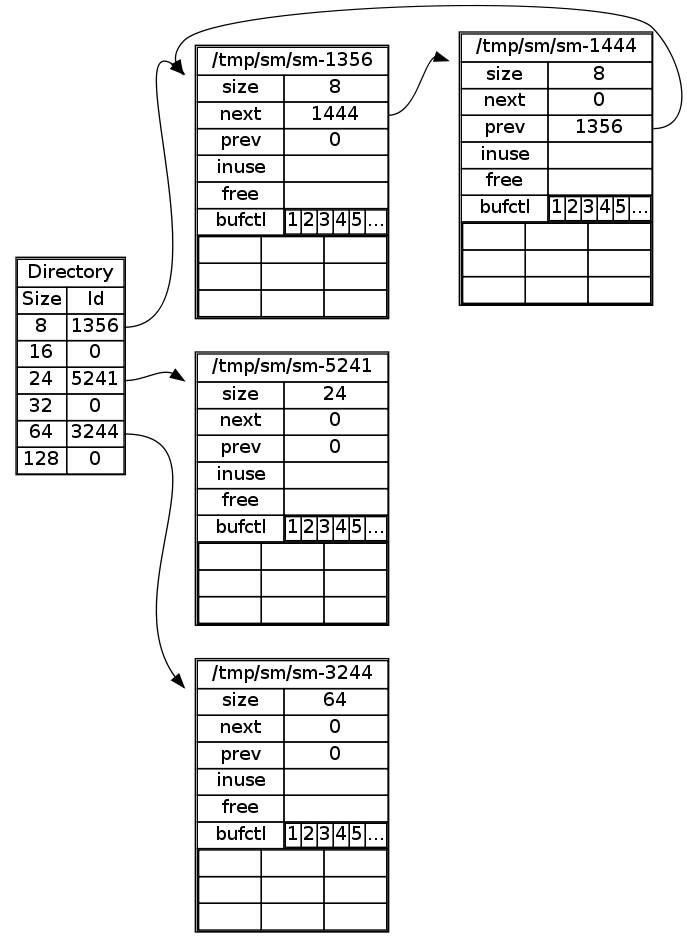
The library you are going to implement will have the structure given in the figure. The Directory page is a shared
memory segment of size 4K containing a directory for slab pages. Directory — not exclusively — contains object
sizes and id of the corressponding slab page. Library will be capable of allocating objects of sizes given in this
directory.
Each slab page has a fixed size (1024*1024 bytes). When a page is full, a new page is allocated and pages are
linked with next and prev links. Each slab page is a shared memory segment. You can use memory mapped files
under a directory like /tmp/sm/id-.. to realize shared memory or use SYSV shared memory ids directly. A page
id is a short, unique integer.
In order to make sure a heap object in this library unique, library represents a pointer as a tuple consisting of slab
page id and the objects position in the slab.
typedef struct sm_pointer {
short pageid;
short objind;
} sm_pointer_t ;
While accessing a pointer, programmer should convert this pointer into an actual memory reference by calling smref() and similarly call smderef() to convert a memory reference to sm_pointer_t. smref() automatically attaches/maps the shared memory if it is not attached yet. Library also should provide locking facilities for allocated objects. It can be realized as locking corressponding file regions of mapped file or maintaining a semaphore array per slab. No need to mention, all library meta-data should be protected against race conditions. Allocated objects are persistent, they survive even after process terminates. The library user is responsible for concurrency and integrity issues like dangling references. You can implement a garbage collector for getting bonus points (bonus B). For garbage collector, you need to keep a reference count per object in the slab, and each process increments this counter when smref() is called. When counter gets 0, the object is deallocated. Counter decrement is explicit through smrelease() call.
You need to implement the following functions:
Initializes the library, attaches/maps the Directory page etc. If directory does not exist, creates it.
Destroys all shared memory attachments/mappings of slabs, deallocates all library internal data
structures for the process.
Tests if the slab page is attached/mapped and finds the object from slab and returns the actual
pointer to it.
Finds the slab page containing the actual pointer and returns the sm_pointer_t typed pointer
to it.
Allocates a new object from the suitable slab (the smallest fixed size that requested size fits). If all
slab pages are full, creates and attaches a new slab page.
Deletes the object from slabs. If deleted object is the last object of slab, the slab is destroyed, the
file is deleted or the shared memory is deleted.
Locks the object for concurrent access. Blocks until lock is established.
Unlocks the object.
(bonus A)
Creates a new slab entry for the size given with integer parameter. It will add a new directory
entry.
(bonus A)
Destroy the directory entry for given size. All linked slabs will be destroyed as well.
(bonus B)
mark the pointer as ‘not to be used by this process anymore’. Garbage collector decrements the
reference count of the object and deallocates it when this counter gets 0. Applications will call this
function instead of smfree().
Please note that you need to keep a bidirectional mapping among slab id and memory address range in each process in order to implement smref() and smderef(). This mapping should be fast. You can use C++ maps or tsearch() in libc as fast data structures.
Bonus A is 10 extra points and Bonus B is 15 extra points worth. A sample program using the library will be provided later.
Please provide your implementation on 4 files in a tar.gz archive (no RAR, no ZIP please):
Please ask all questions to:
news://news.ceng.metu.edu.tr:2050/metu.ceng.course.536/
https://cow.ceng.metu.edu.tr/News/thread.php?group=metu.ceng.course.536